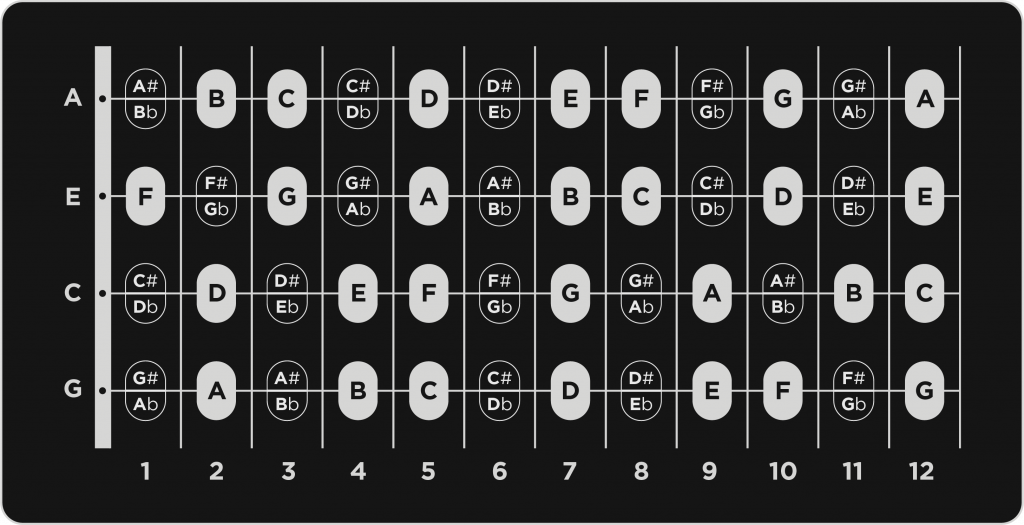
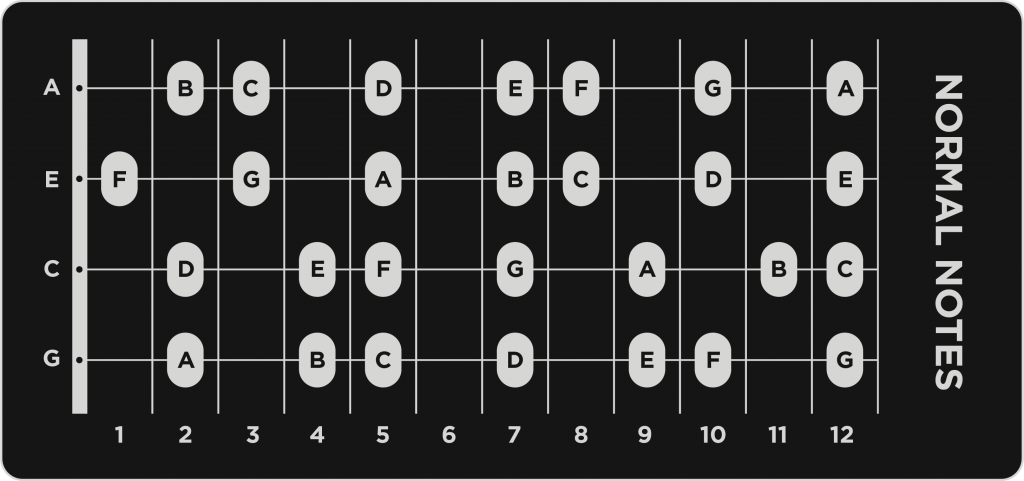
Each note that you’ll learn to play on the ukulele will be a part of what is known as the chromatic scale. This scale consists of the 12 notes standard in Western style music. This 12 note set starts with seven “pure notes.” The NORMAL notes of the scale are: A – B – C – D – E – F – G
In between most of these notes there is a sharp and flat. Together, they complete the 12 note set that is described as an “octave.” Once you complete the 12 notes, you’ll start over with the same notes, just an octave higher or lower. You’ll notice that there are no enharmonic notes (flats or sharps) between notes B and C, or E and F.
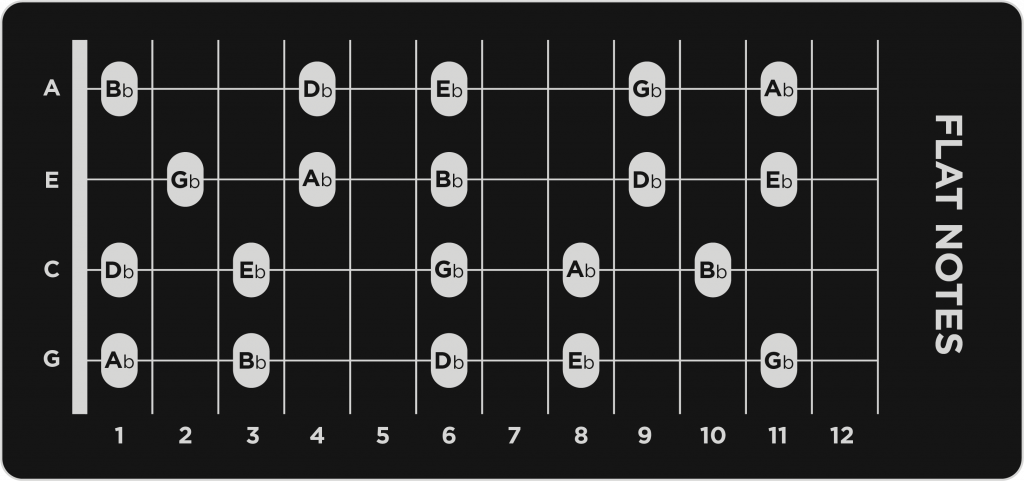
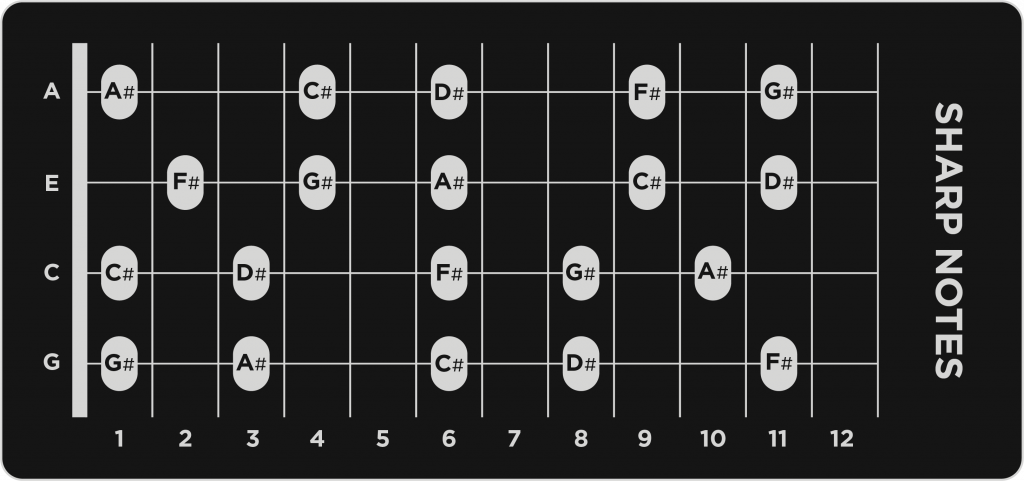
On the ukulele, each fret is only “half a step,” or half a note, apart. The in-between notes are named with sharps (#) and flats (b). A sharp is half a step up, and a flat is half a step down.
For example, a “Bb” (or “B flat”) is half a step down from the B note, but not yet an A. An “F#” (or “F sharp”) is half a step up from F, but not get a G.
With sharps and flats added in, the scale looks like this: A – A#/Bb – B – C – C#/Db – D – D#/Eb – E – F – F#/Gb – G – G#/Ab
Although the half steps are described as either “sharp” or “flat,” they are essentially the same note. In other words, A# and Bb are the same note.
Most of these notes tend to be described more often by one name than the other; Bb is more common than A# for example. However, both names are technically correct.